
Creelo: AI Filmmaking Workspace
Summary
Creelo is the work of Jammi, my long-time collaborator, who architected and leads the product. I contributed roughly 30 percent of the build, focused on three areas I owned end to end: the MCP server that lets any AI agent drive Creelo programmatically, the voice and music generation integration, and the credits system that meters every generation. Creelo is live at creelo.app and produces the real marketing video content for Agentic Realty, my own platform, which is how the two projects feed each other.
Project Snapshot
My Role
Contributor (~30%) · Product built and led by Jammi
Duration
2026 · ongoing
Context
Creelo, my collaborator Jammi's AI filmmaking product
Outcome
Live at creelo.app · drivable by any MCP-compatible AI agent · producing real marketing video for Agentic Realty
Stack
The Problem
Context
Creelo targets African creators and small brand owners in Ghana, Nigeria, and Kenya who need a constant stream of on-brand video but can't afford professional production. It positions itself as the place where AI filmmakers build their projects, not just another editor.
The Pain
Making one short branded video today means juggling a generation tool, a separate editor, a voice tool, and music sourcing, then stitching the results together by hand. Each tool has its own pricing, its own exports, and its own learning curve.
Why It Mattered
For a small brand, video is the highest-converting content format and competitors post daily. If the tooling is too fragmented or too expensive, the videos simply don't get made.
Goals & Requirements
Technical Goals
- One workspace from prompt to render: generate video, image, voice, and music, then edit on a timeline without leaving the tool
- Two modes: Director for generation-first work (prompts, reference chips, model picker) and Editor for a full multi-track timeline with transform and camera controls
- Expose the entire pipeline over MCP so any compatible AI agent can generate media, build timelines, render, and publish without touching the web UI
- Meter every generation in credits, with the exact cost shown before the user spends anything
- A complete voice pipeline: voiceover, voice cloning, voice change, and translation, with per-voice, model, speed, and language controls
Constraints
- Generation models are third-party, slow, and asynchronous, so every operation must be task-based with status polling rather than blocking requests
- Different models bill in completely different units, so all costs must normalize into one credit currency checked against balance before a job runs
- The audience is solo creators, so the pricing and the UX both have to stay simple no matter how much machinery sits underneath
Architecture Design
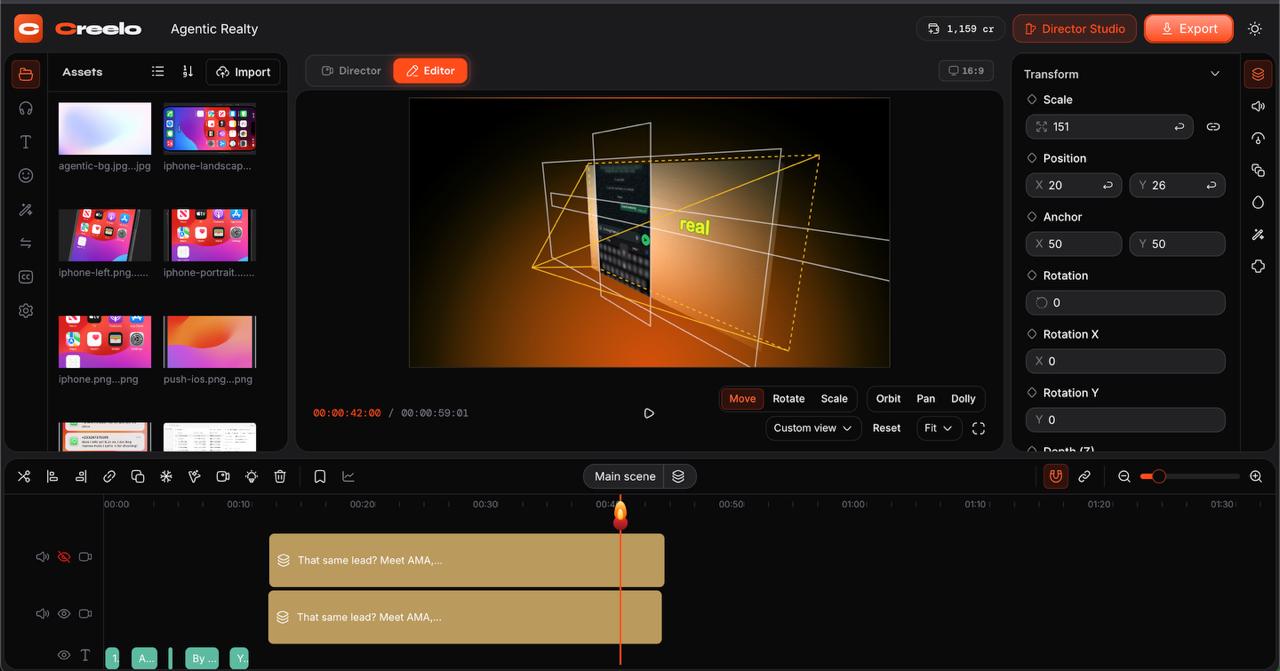
Creelo pairs a generation engine with a non-linear editor over a shared asset library. Director Studio is the generation-first mode: describe what you want, attach reference images, video, or audio via @ chips, pick a model such as Seedance 2 for text-to-video or ElevenLabs Flash for voice, and the result lands in the Generated Assets library ready to drag onto the timeline. The Editor is a full multi-track NLE with a 3D-style transform panel and camera controls. Around that core sit the pieces I built: an MCP server exposing the same operations programmatically, the voice and music generation integration, and a credits ledger that meters every job.
Scroll horizontally on smaller screens to view full diagram
Component Breakdown
Director Studio (Jammi)
Generation-first mode: prompt box with @image/@video/@audio reference chips, model picker, aspect ratio, duration, and resolution controls, with the credit cost shown before you generate
Editor (Jammi)
Multi-track timeline with a full transform panel (scale, position, anchor, rotation, depth), orbit/pan/dolly camera controls, and cut, align, group, keyframe, and effects tooling
MCP server (my area)
Exposes Creelo's pipeline as MCP tools: import and register media, generate image, video, music, and voiceover, clone voices, lipsync, transcribe, build and save timeline projects, render, schedule and publish posts, and read analytics and credit balance
Voice & music integration (my area)
Wraps voice models like ElevenLabs Flash behind a voice panel with picker, speed, and language controls plus Voiceover, Clone, Change, and Translate flows, and routes music generation into the same asset library
Credits system (my area)
Normalizes per-model costs into one credit currency, shows the exact cost before a generation runs, checks balance, and deducts per job
Generated Assets library
Every generation, whatever produced it, lands in one filterable library (Video, Image, Voice, Avatar, Music) that both the UI and the MCP tools draw from
Key Design Decisions
→MCP as a first-class interface, not an add-on
Any MCP-compatible chatbot or agent can drive Creelo's generation and editing tools directly. That turns Creelo from a standalone app into a programmable video backend that other AI products can build on, which is a much bigger surface than a web UI alone.
→One credit currency across heterogeneous models
Video models bill per second, voice models per character, image models per generation. Users shouldn't need to understand any of that. Everything converts to credits, and the cost appears next to the generate button before you commit.
→Task-based generation everywhere
Model latency ranges from seconds to minutes. Every generation returns a task with status, a wait operation, and history, so both the UI and MCP clients handle long jobs the same way instead of holding connections open.
Implementation Breakdown
The workspace itself (Jammi's build)
For context on what my pieces plug into: Jammi built the two-mode workspace that is the heart of Creelo.
- Director Studio: prompt-driven generation with reference chips, model and format controls, and Enhance, Sound, and @ Elements quick actions
- Editor: multi-track timeline (video, text, camera, and rig layers) with a transform panel covering scale, position, anchor, rotation, and depth, plus orbit, pan, and dolly camera moves
- A shared asset panel (Uploads and Generated) feeding both modes by drag and drop
The MCP server: Creelo as a platform
My largest contribution. The MCP server exposes Creelo's whole pipeline as tools that any MCP-compatible agent can call, covering the same operations the web UI performs.
- Media operations: request upload URLs, upload and import media, register generated media into the asset library
- Generation operations: image, video, music, and voiceover generation, voice cloning, lipsync, video extension, transcription, and b-roll search
- Project operations: build, save, and load timeline projects, render them, and fetch renders
- Publishing operations: schedule posts, publish immediately, cancel, list channels, and read post analytics and best posting times
- Long-running jobs are surfaced as tasks with get, wait, and history operations so an agent can fire a generation and come back for it
Voice and music generation integration
Creators think in voices and moods, not API parameters. This layer wraps the raw generation APIs into flows a non-technical user can drive.
- Voice panel: script box, voice picker, model selection (ElevenLabs Flash), speed and language controls
- Four flows on one surface: Voiceover, Clone, Change, and Translate
- Music generation routed into the same Generated Assets library, filterable and draggable onto the timeline like any other asset
The credits system
Metering is the difference between a demo and a product. Every generation costs credits, and the user always sees the price before spending.
- Per-model cost normalization so a video generation and a voiceover are comparable on one number
- Cost displayed on the generate action itself (for example, Cost 395 cr) against the visible balance
- Balance check before a job starts and deduction per completed generation
Challenges & Solutions
#1Exposing long-running AI generation over MCP
The Problem
A video generation can take minutes. An MCP client can't sit inside one blocked tool call that whole time, and an agent driving Creelo needs to know whether a job is queued, running, done, or failed.
The Fix
Every generation operation returns a task. Clients poll status, use a dedicated wait operation, or check task history. Finished media is registered into the asset library, so later steps like timeline building and rendering can reference it by id regardless of which client created it.
#2One price for many models
The Problem
Seedance bills video by the second, ElevenLabs bills voice by the character, image models bill per generation. Passing that complexity to a solo creator in Accra or Lagos kills the product.
The Fix
All model costs normalize into credits at generation time. The exact credit cost renders next to the generate button before the user commits, the balance is checked before the job is accepted, and the deduction happens per completed job.
#3Making voice generation feel like a creative tool
The Problem
Raw text-to-speech APIs are a string-in, audio-out box. Creators need to pick a voice, control pacing and language, clone a voice they own, or translate a finished voiceover.
The Fix
One voice panel wraps all of it: voice picker, speed and language controls, and Voiceover, Clone, Change, and Translate as tabs on the same surface, with every result landing directly in the asset library and ready for the timeline.
Results & Impact
Creelo is live at creelo.app. It already produces real production content: the marketing video for Agentic Realty is built in Creelo, from phone-mockup source assets through voiceover-driven scenes on synced timeline tracks. Through the MCP server, any compatible AI assistant can drive the same pipeline programmatically.
Before → After
Brand video production
Programmatic access
Voiceover
Business Outcome
Creelo is positioned for African creators and small brand owners in Ghana, Nigeria, and Kenya. The Agentic Realty work doubles as proof: my platform's UI screenshots become Creelo source assets, and Creelo's renders become our ads. One product markets the other.
Reflections
Would Do Differently
- 01Define the credit cost model before wiring the first generation model. Retrofitting per-model pricing onto features that already work is much harder than designing for it
- 02Build task history and status introspection at the very start. Debugging asynchronous generation without visibility into the task queue is guesswork
Key Takeaways
- 01An MCP server turns a product into a platform. The same tools that power Creelo's own features let any AI agent use Creelo as its video backend
- 02Metering is a product feature, not plumbing. Showing the exact credit cost before a generation builds more trust than any pricing page
- 03Contributing inside someone else's architecture is its own skill. Jammi set the direction, and my job was to ship pieces that fit his patterns cleanly rather than working around them
Next Project
Kysoo: No-Code Voice Agent Builder
AI Voice Agents